Children learn about Elephants

by Mary Ann on August 29, 2011

paper plate elephant craft with  wrinkly nose

Jack's elephant with the wrinkly nose

Jack wanted to learn about elephants! He mentioned it for two weeks. So this last Traveling Closet was all about elephants. I had a ton of things to do and we only got to a portion of them. However, I am going to share all the resources I took with me. You can spread them out over a week’s time. There are tons of books, two elephant crafts for kids, two fun games, two great songs and a darling snack.
elephant movies picture

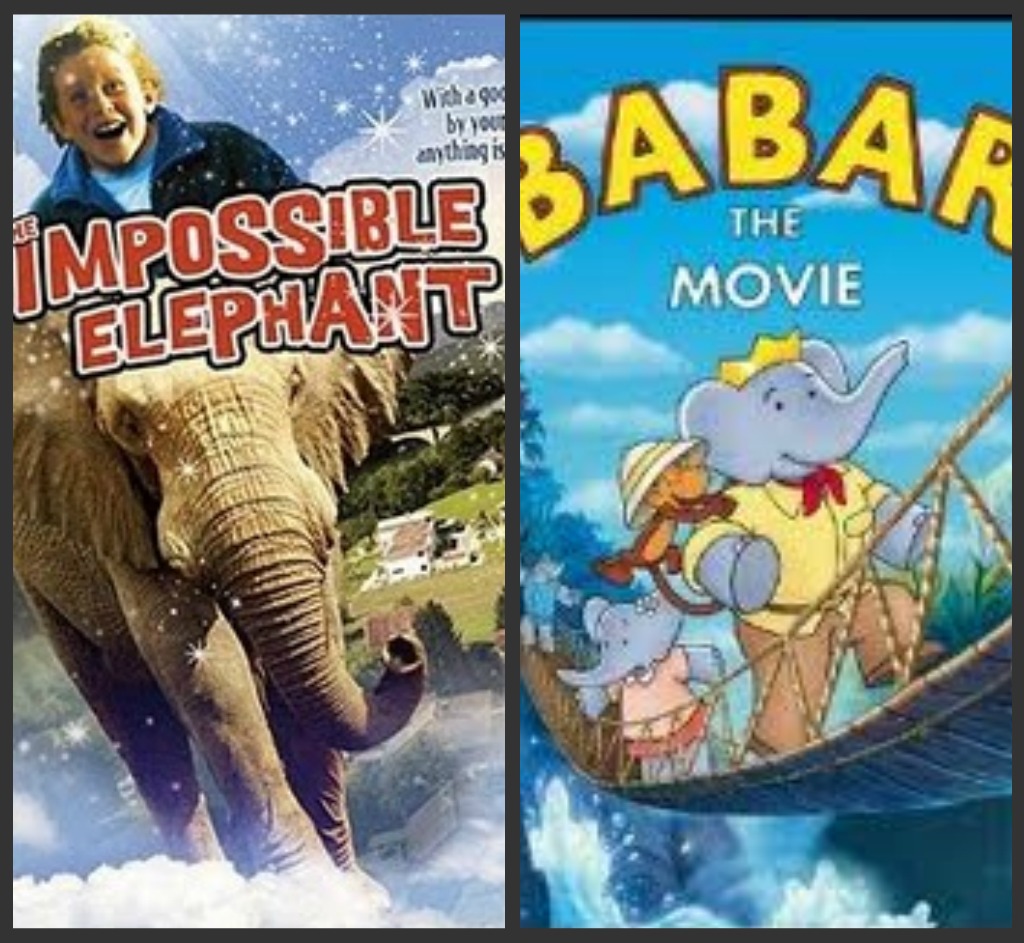
Two elephantastic movies

We began with a book. It seems like we always begin with a book. Hmmmm thinking back, we actually  began on Monday with an elephant video for kids called “The Impossible Elephant”. The children loved watching a real elephant. We talked about how they walked, that baby elephants have fuzzy heads and that they use their trunks just like hands. We also had the Babar Movie but they liked the real deal better. The Impossible Elephant held Mary’s attention (she is 20 months old) and would probably entertain up to 10 or 11.

So on Friday at Grandma School we began with a book. We read all about a baby elephant and how he played in the water with all of his very hot and tired friends.

Elephant Crafts for kids:

Then we made a paper plate elephant craft, a darling elephant with (as Jack put it) a wrinkly nose. He just couldn’t get the hang of fan folding but we had fun working it out. Mary loved gluing. Mhmmm, just gluing. She used her Qtip to glue under the eyes, on top of the eyes and everywhere else we would let her. She tasted it and liked it and tasted the glue again. YUCK!
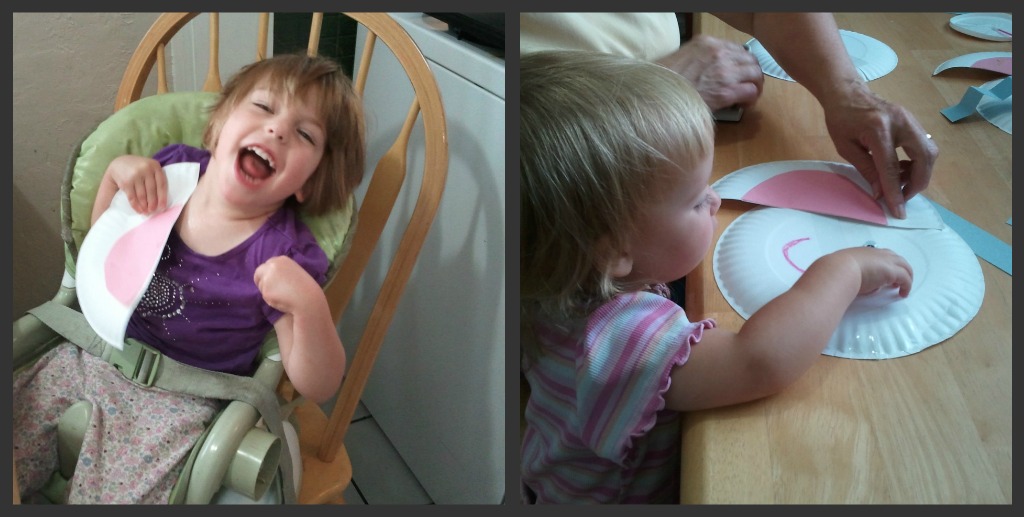
making elephant ears with paper plate

Maggie and Mary making elephant ears

Another fun elephant creating craft looks like this. Just a little hand print with ears added.
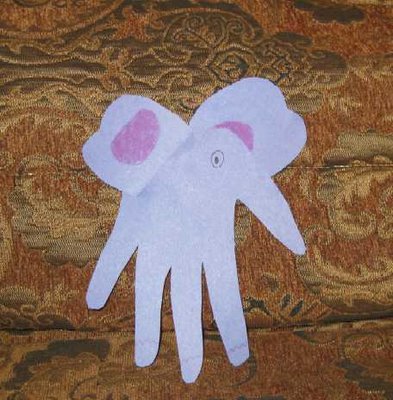
elephant handprint craft picture

Small hand prints marching through the jungle!

Elephant Songs for Kids:

We sang two elephant songs. They were easy and to the tune of The Farmer in the Dell and Did You Ever See a Lassie.

Did You Ever See An Elephant – spray water with his trunk, eat peanuts, hug her baby, etc.

The Elephants are Here – the elephants are exercising now, spinning around, touching their toes, are all exhausted now, etc.

We all enjoyed the activity of moving around and singing and dancing.

Elephant Games for Kids:

I had a wonderful game which we didn’t play called Pass the Peanut. Slide daddy’s socks up over the child’s arm leaving them hanging wrinkled on the arm and hand. Then a child passes a peanut (in this case we used a small ball) to the next child and so forth. It isn’t as easy as it sounds with a wrinkled sock on you hand!

Here is another game that is really fun called “What’s in the Box?” You put some small items in a box such as a spoon, comb, ball, banana, etc. Then each child takes a turn feeling in the box with their sock covered trunks. They pick an item and then try to guess what it is by feeling it.

Of course we read a few more books. We had one book which showed what an elephant looks like on the inside and what a baby elephant looks like inside his mother. We also saw a person, elephant and blue whale compared to each other. If you think the elephant is REALLY big, think again!

Painting like an elephant activity:

Our favorite activity by far was painting like an elephant. We had a fabulous book which showed elephants learning to paint along side children. They do a pretty fair job of it too. One elephant painting sold for $39,000. Imagine. We taped the brushes to the back side of our hands and then painted as if it was our trunk. Maggie who has Cerebral Palsy really did well with that. The little boys didn’t like the brush tapped on their hands and so we eventually went back to hand painting, except Mary who tried mouth painting!
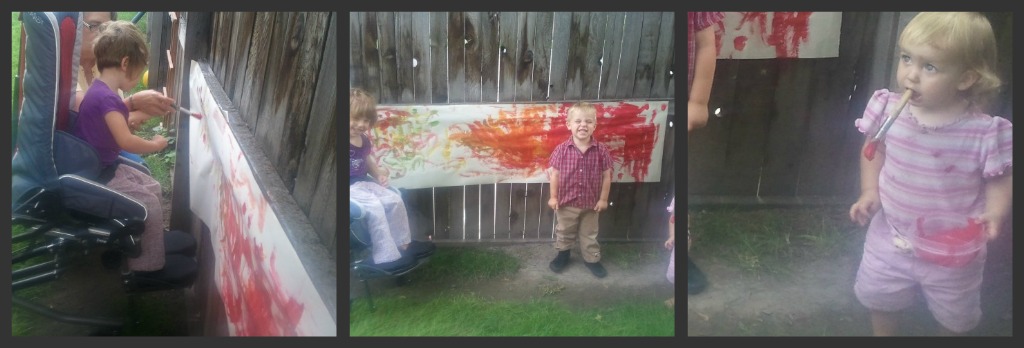
kids painting like elephant

Painting like elephants

For our snack we made biscuit elephants. Now that was a project that everyone could get into. You start with an inexpensive can of rolls. Ours sat out on the table for too long. When I banged the container on the table five rolls blew out, flew through the air and smacked Maggie on her face and head. We laughed and laughed.
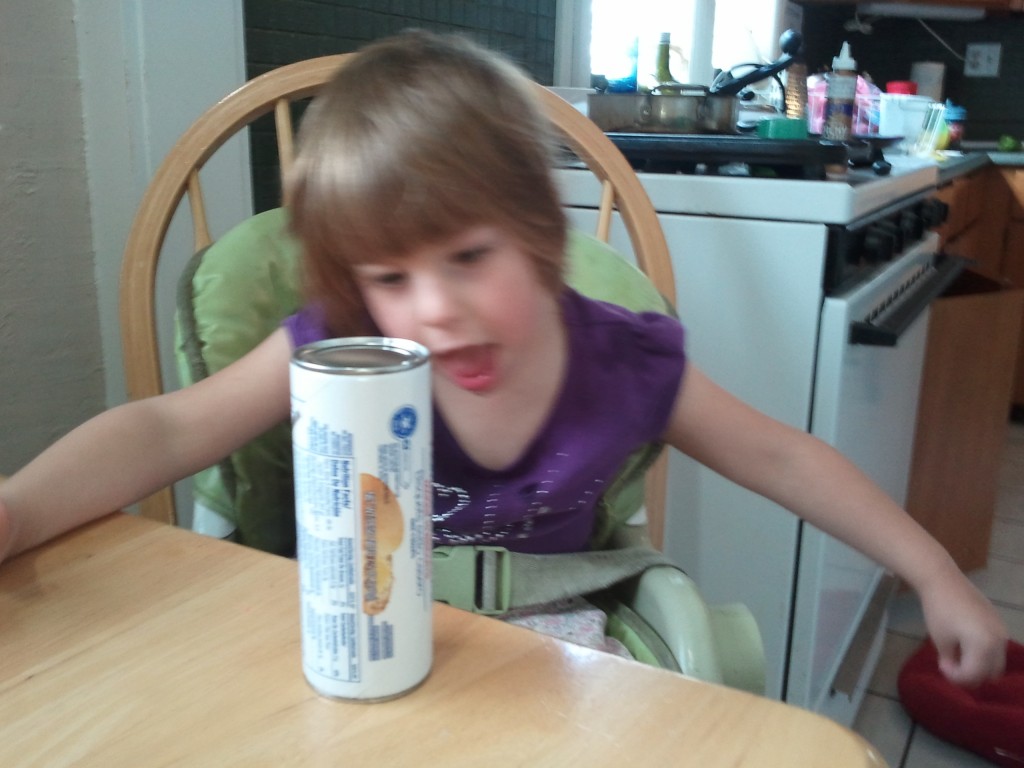
little girl with her baking roll

Maggie excited to bake, just before the biscuit explosion!

You use butter knives or plastic knives to make two cuts in the biscuit. That creates the ears and truck. Pinch the trunk together until it looks more trunky. Add raisin eyes and sprinkle with brown sugar. Bake at 400 degrees for 10 minutes.
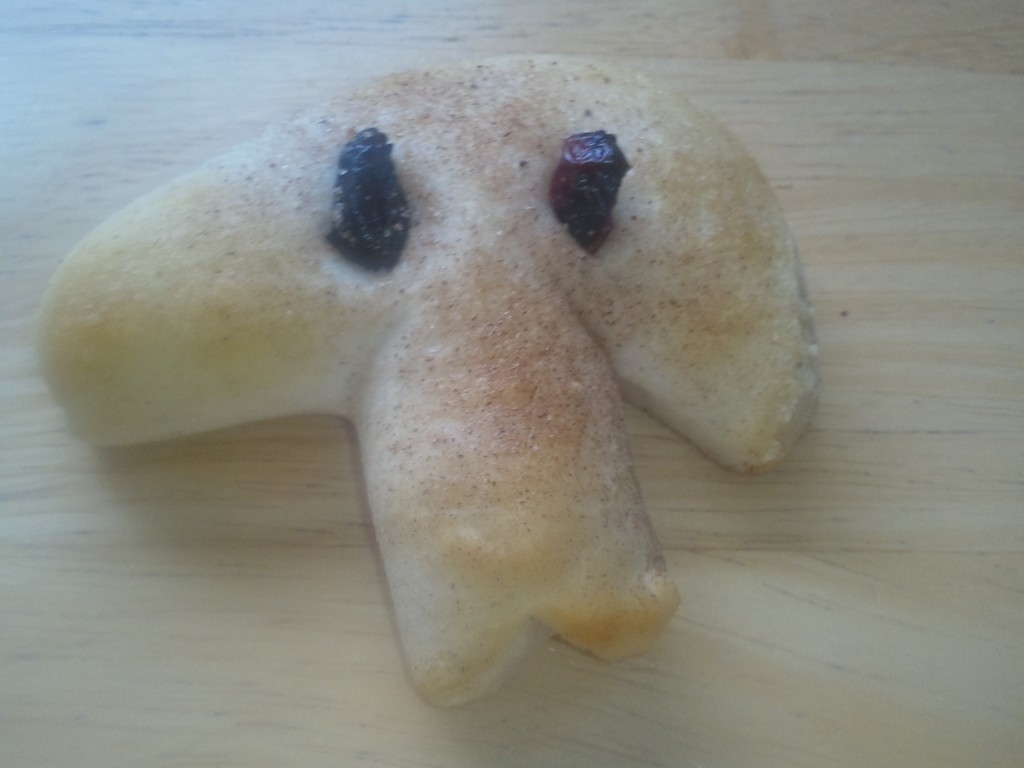
biscuit elephant picture

Our elephant biscuits

At the end of the day Jack said, “Thanks for learning us stuff grandma!” Have elephantastic time learning all about these mighty and gentle creatures.

Elephant Facts for Kids:

  • There are two types of elephant, the Asian elephant and the African elephant (although sometimes the African Elephant is split into two species, the African Forest Elephant and the African Bush Elephant).
  • Elephants are the largest land-living mammal in the world.
  • Both female and male African elephants have tusks but only the male Asian elephants have tusks. They use their tusks for digging and finding food.
  • Female elephants are called cows. They start to have calves when they are about 12 years old and they are pregnant for 22 months.
  • An elephant can use its tusks to dig for ground water. An adult elephant needs to drink around 210 litres of water a day.
  • Elephants have large, thin ears. Their ears are made up of a complex network of blood vessels which with regulating an elephants temperature. Blood is circulated through their ears to cool them down in hot climates.
  • Elephants have no natural predators. However, lions will sometimes prey on young or weak elephants in the wild. The main risk to elephants is from humans through poaching and changes to their habitat.
  • The elephant’s trunk is able to sense the size, shape and temperature of an object.
  • An elephant uses its trunk to lift food and suck up water then pour it into its mouth.
  • An elephant’s trunk can grow to be about 2 metres long and can weigh up to 140 kg. Some scientists believe that an elephant’s trunk is made up of 100,000 muscles, but no bones.
  • Female elephants spend their entire lives living in large groups called herds. Male elephant leave their herds at about 13 years old and live fairly solitary lives from this point.
  • Elephants can swim – they use their trunk to breathe like a snorkel in deep water.
  • Elephants are herbivores and can spend up to 16 hours days collecting leaves, twigs, bamboo and roots.

Elephant Books for kids:

  • How to Catch and Elephant by Amy Schwartz
  • Picture Library: Elephants by N. S. Barrett
  • I Dream of an Elephant by Ami Rubinger
  • Elephants Can Paint Too by Katya Arnold
  • Splash by Flora McDonnell
  • Oliver by Sid Hoff
  • Hurty Feelings by Helen Lester
  • Faithful Elephants by Yukio Tsuchiya
  • The Babar Series by Jean de Brunhoff
  • Dr. De Soto Goes to Africa by William Steig
  • Tacky in Trouble by Lynn Munsinger
  • Bernard Goes to School by Joan Elizabeth
  • What did One Elephant Say to another by Becky Baines (The kids loved this one)
  • Elephants (Zoo Book) by John Bonnett Wexo
  • The elephant book by Ian Redmond
  • Endangered Species: Elephants by Peter Jackson
  • Elephants by Gloria G. Schlaepfer
  • Hnasa: The True Story of an Asian Elephant Baby by Clare Hodgson Meeker
  • Elephant Hospital by Kathy Darling


Possibly Related Posts:


{ 0 comments }

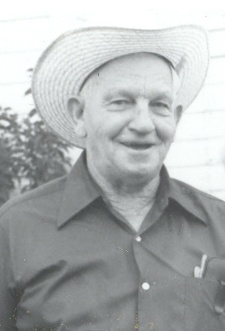
vintage picture of my grandpa who is an entrepreneur

My grandpa Ted, entrepreneur

I was seated in a red vinyl chair, one in a row of chairs, the kind you would have seen in a 1940’s dinner. I was waiting for a customer and I knew one would come. One always came when my grandpa was away from the store. Yup, here came a tall six foot cowboy with a size 14 foot. I know his foot size because this was a shoe/boot shop my grandpa owned and right now I was in charge. I was 10 or 12 years old.

I had the tall cowboy sit down and I asked him what he was looking for, a fancy boot, a riding boot, maybe a steel toed work boot. Then I measured his foot on the old wooden sizer. I felt soooooo grown up. After all I had been measuring men’s feet since I was about 8 year sold, every time my grandpa took a break next door in the Golden Spur Cafe. I had never yet sold a boot but I had shown a good many cowboys a good many boots.

Here is what I didn’t know. My grandpa was sending those cowboys over to give me experience. Every day that I stayed with my grandparents in the summer time I worked in the shoe shop. Grandpa didn’t sell women’s shoes, just sturdy work shoes and boots. He also repaired them and the scent of glue and leather made the shop a wonderful place to be. My grandpa had only a high school education but he taught himself  a new trade  and then how to use that skill to create and run a successful business for many, many years.

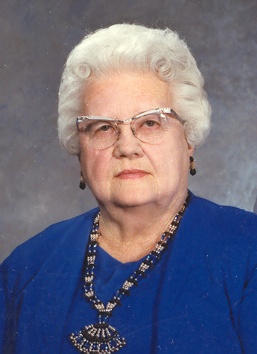
Picture of my grandma who is an entrepreneur

My grandma Rose, entrepreneur

At night I would find myself behind the counter in my Grandma’s Sweet Shop. My grandma had only a fourth grade education but she taught herself what she needed to know to run a successful business for many years. It was right next to the theater and in those days there were no concessions inside the theater. You had to come to my grandma’s Sweet Shop to get them. After the movie or the high school football game you could come in and sit down and treat your date to a lime ricky, an ice cream soda or a foot long hot dog with her famous and very secret sauce. Mostly I washed root beer mugs and ice cream dishes but occasionally I had the privilege of selling pop corn and candy. It was a delicious experience no pun intended!

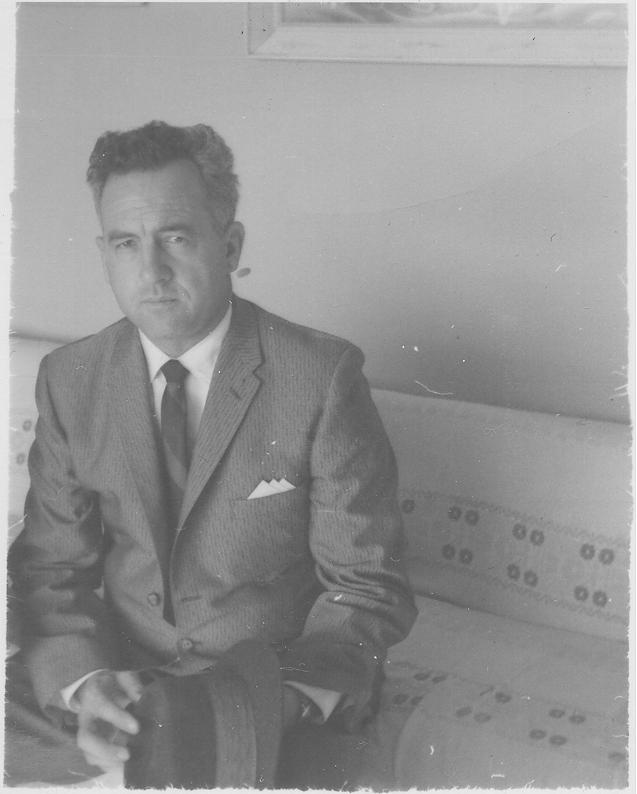
vintage photo of my dad who is an entreprenuer

My father Verl, entrepreneur

My dad was an entrepreneur. I learned what that big word meant in high school but although I didn’t know the word till then I knew what one was. It was a person who owned their own business; who kept the books and hired people and paid the bills and sometimes didn’t get paid himself. I knew it was somebody who was always thinking up ideas and putting them into practice. He went back to school when his ninth child was born and got his bachelors, masters degree. But long before those days he had been a school teacher and had started and run numerous businesses. When he was a very young man he taught himself about refrigeration and then built and repaired refrigerators.

vintage photo of me as a little girl

Me, learning about entrepreneurship

I learned about entrepreneurship and work by being involved with them from my earliest days. Entrepreneurship  was once passed from one generation to the next seamlessly. That is what shop keepers and tradesmen did, the potters, smiths, bakers, dressmakers, the tailors, butchers, contractors, grocers, etc. They passed on their knowledge and often included their children in their work. This call to work was part of the strength of my personal core phase. I learned to have an entrepreneurial sprit by living with people who had it. I passed it along to my children unconsciously because my example to them was of a stay at home mom who was always working on some venture or another. Many of our family perks came from those ventures.

I will never forget the summer my five year old Jodie set up a rock selling business. She collected rocks on the side of the road and went door to door selling them. She sold some too. Her next venture was a large cardboard box christened “Junky Jimbo’s” (don’t ask me where she got that name!!) on the corner of a busy street where she sold lemonade. And so it went with all of my children.

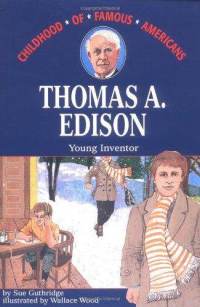
It is important to show our children how to work, how to think, how to ask good questions and how to bring more value to the world. Here is a book which I recommend that is a great example of what happens in an educational sense when a child has acquired good core values and has learned to love learning.  It is a great example of natural entrepreneurship.

childhood of famous americans book picture“Childhood of Famous Americans-Thomas Edison Young Inventor” by Sue Guthridge

Thomas loved learning! He was nine and a half when his mom pulled him out of school. He could not read yet. His mom inspired him by reading stories from history. Yup, that was her method of teaching him to read. She read to him. Thomas had a tower that he
would climb and pretend he wasColumbus seeing the shore line for the first time. He charged neighbors for the opportunity to climb the tower to be able to see the lay of the land.

In his teens he worked on a train. He worked on the train in the morning during the morning commute fromDearborntoDetroit. Then he would spend the day at the Detroit Free Library. There were over 3000+ volumes and he read every one of them. In the evening he would work on the train back to his home inDearborn.

At that time the telegraph was new. Thomas thought about this new invention and soon had an idea. When the train stopped at each town with a telegraph office he would run to the office, get the breaking news on the Civil War and then run back to the train, type set the news and then sell the information in a little newspaper to the passengers. He was definitely an entrepreneur!

I am grateful that my parents and grandparents taught me that I could create work. I have had my share of jobs and some of them have been wonderful. But whenever I needed money I knew I could come up with an idea, just like Thomas, that would bring me the money I needed. It has made a world of difference for me and my family.


Possibly Related Posts:


{ 0 comments }

What is Labor Day about: Teach Children

by Mary Ann on August 24, 2011

labor day clip arts

labor day clip art with american flag

When I was girl I lived in a series of small towns. Just before the start of the new school year there was a holiday called Labor Day. I had no idea what it was about but I knew it meant school was starting.

In the small towns that I lived in there was always a big celebration with a parade down main street, a BBQ in the park and boring speeches by important people. Over the years, whenever Labor Day rolls around someone in my family will ask, “What is the Labor day holiday for?” and someone else will reply “I think it must have something to do with working or working people”. If a child asked an adult “Why do we celebrate labor day?” they might hear “It’s a day to celebrate how much work it was to bring you into the world and then take care of you”.

workers in labor day parade

Labor Day - Celebrating American Workers

I thought it might be interesting to fill you in on what Labor Day is all about so that when your child asks you, you can give them a real answer and not be a wise acre! How about an activity or two that you can do as a family to learn about and celebrate the day.

History of Labor day:

• Labor Day is celebrated on the first Monday in September. It’s a day dedicated to the everyday worker. This holiday gives tribute to the working class contributions to the strength, prosperity, and well-being of our country. Labor Day became an official national holiday in 1894. This holiday is usually celebrated with summer activities – swimming, camping, picnics, etc. Labor Day is the unofficial end of summer in the Northern part of the U.S. Most schools usually start sometime during the week after Labor Day.

labor day clip art with mickey

Labor Day became a National Holiday on June 28, 1894

Labor Day Activities and Ideas:

•This labor day why not have a family program in your living room and show your children what labor you perform in your comunity. Maybe you are a doctor, teacher, salesman or nurse. If the timing is right go on a field trip and show them where you work. You might round out the program by having each person in your family share what it is they think would be the most fun work to do when they grow up. Then don’t forget the treats.

• Take some time, at dinner for example, and talk about all the contributions children can and do make. Here are some ideas – Baby sit, Deliver newspapers, magazines or flyers, Walk dogs/care for pets, Do yard work, grass cutting, Help a neighbor with chores, Do chores in your own home, Be a tutor, Help out at kids clubs, Teach computer skills, Volunteer. All of these things are important because they contribute to society – kids do make a difference.

honor labor pictures

Work is good for everyone

• Make a collage by cutting pictures out of magazines of people doing different kinds of work.

Teaching Children the Importance of Work

• At another meal you could discuss why it is important to work and what we can learn: Money Management -You quickly learn the value of money when you earn it yourself. Time management – You will learn how to manage your time, be organized, and set schedules so you can get your work done and still have time for school and play. Responsibility – When you make a commitment to take on work or chores or do Volunteer work, you have to follow through because people are counting on you. Setting Goals – you want that bike? Set the goal and go for it. Work teaches you this.

Labor Day Games and Puzzles

• Make the game Tools of the Trade and then have a family game night and play it. Serve pop corn. Just make cards showing a tool from many different occupations. Use blank index cards) Make two cards for each tool. (hammer, dentist drill, garden rake, semi-truck, judges hammer) Then play the game just as you would Memory. Take turns turning over two cards until a match is found. The person with the most matches is the winner. Part of the fun is in choosing the occupations and then deciding on a tool for each.

Print off some super Labor Day Wordsearch puzzles.

Labor Day Crafts

Look here to find some great crafts to help teach your children about Labor Day.

Short Stories for Labor Day

Follow this link to print out some  short stories to share each day of the week before Labor Day. Here is just a small sample of what you will find. The Smithy by P. V. Ramaswami Raju, Indian Fables; Hofus the Stone Cutter, A Japense Legend from The Riserside Third Reader; Arachine by Josephine Preston Peabody, Old Greek Folk Stories; and The Champion Stone Cutter by Hugh Miller

• Choose a book or two about working to read in your family reading time. Here are a few to choose from.

Labor Day Books to Read to Children

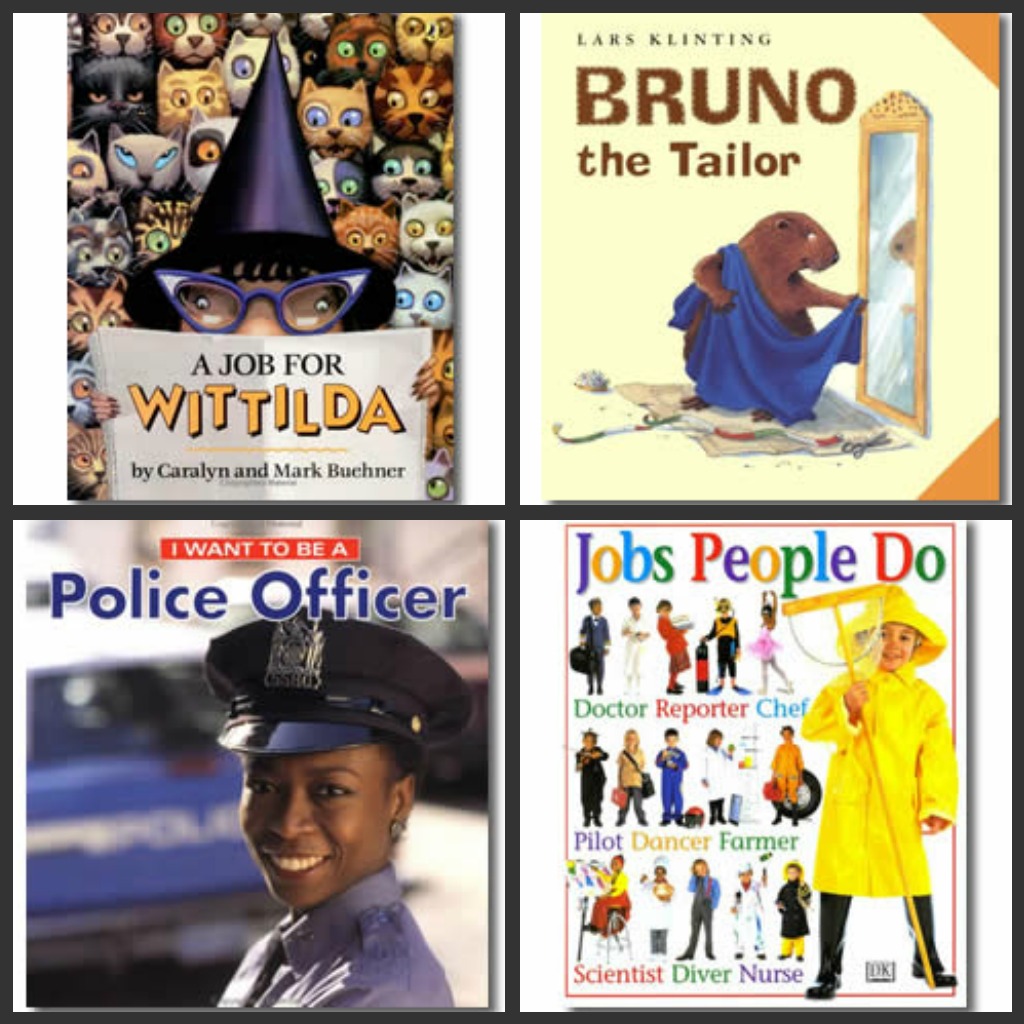
A Job for Wittilda by Caralyn Buehner – Wittilda the Witch needs to provide for her 47 cats. She seeks a job that matches her talents. She finally gets a chance to deliver pizzas. Her broom helps her go faster than her competition. However, just when everything is going great, she is forced to make a decision that concerns a stray kitty. The time it takes to rescue this friend, could cost her the pizza delivery job.

Bruno the Tailor by Caralyn Buehner – Bruno the Tailor, decides to make himself a new apron. First he needs some fabric which he must find in his messy sewing room. Then he washes the fabric, hangs it up to dry, then irons it carefully. Bruno takes his measurements, makes his pattern, pins it to the fabric, and cuts out the garment. He bastes all seams and pockets into place, then sews the apron on the sewing machine. The beaver is very proud of his work. Illustrations are in colored pencil and watercolor. This is a great book that displays steps in completing a project. It even comes with a pattern so readers may make their own apron. A great book to share that describes the work of a tailor.

I Want to be a Police Officer by Daniel Liebman – Great photographs can be found in this book. Through photography, the book stresses the friendliness of police officers and how they like to help people.

Jobs People Do by Christopher Maynard – This is the book for helping children find out all about the careers that interest them. Entertaining text and photographs of real children dressed for each hob help youngsters explore 50 different careers, from chef to scientist. Pages also detail the duties and training required for each one.

labor day books pictures

Community Helpers from A to Z (Alphabasics) by Bobbie Kalman
Fireman Small by Wong Herbert Yee

I Want to Be a Teacher by Daniel Liebman

Library Lil by Suzanne Williams

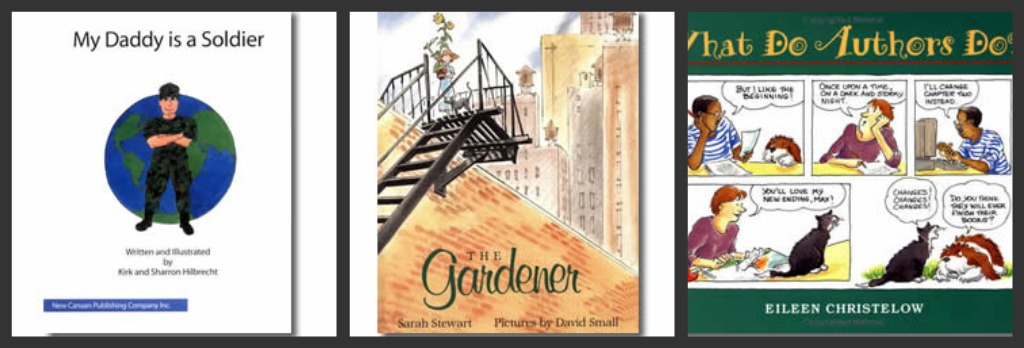
My Daddy is a Soldier by Kirk Hilbrecht – A wonderful book sharing how children view the military. It helps children understand what soldiers do for a living and how their living affects their family.

Officer Buckle & Gloria by Peggy Rathmann

Sam Who Never Forgets by Eve Rice

The Gardener by Sarah Stewart – Sent to the city to live with her Uncle Jim, Lydia Grace writes to her farm family about the big city. She makes friends with the workers at her uncle’s bakery. Lydia tries to bring a little bit of farm to her new city home. She creates a garden on the roof of her apartment and turns it into a magical place – magical enough to bring a smile to her uncle’s face – something that she noticed was missing when she first arrived.

labor day kids books images

Tortoise Brings the Mail by Dee Lillegard

Walter the Baker by Eric Carle

What Do Authors Do by Eileen Christelow – A great explanation to how books are made – from creation to production. It offers a humorous account of some of the ways authors get their ideas and how they put them in writing. Readers follow the complicated process of rejections, acceptance, editorial sessions, and rewrites. The process describes technical details about printing, layout, proofing, and binding.

What Do Illustrators Do? by Eileen Christelow

What is a Communtiy from A to Z? (AlphaBasiCs) by Bobbie Kalman

Follow this link for descriptions of all of these books.

Share these fun family ideas to celebrate Labor Day with other families by clicking the buttons below. : )

Possibly Related Posts:


{ 0 comments }

Teaching Children Mathematical Reasoning Skills

by Mary Ann on August 22, 2011

colorful sticker pictures

Jack's amazing straight line pattern!

One more math article!!!! Here is what happened. I go to the library once a month and get the books to cover four weeks worth of topics. Well, the last time I went I found so many fabulous math and pre-math books that I just couldn’t resist. Out of that one set of books we have had three math weeks – Teaching children Geometry and Math through Shapes, Basic Math Concepts and Ideas for Preschoolers, and now Mathematical Reasoning Skills.

This week we focused on activities to teach patterns and same/different. I could have split patterns and same and different into two weeks but it is time to move on and return to math in a few weeks or months.

It is very important to children’s mathematical reasoning abilities to be able to classify objects or describe positions and patterns. When they can do this they are learning to make logical decisions that organize their world. They have to notice different objects properties or attributes and then make decisions based on them. You can assist in developing  childrens awareness of patterns by helping them look for them in their world. Patterns are commonly found in nature and in things that people make. Developing children’s awareness of patterns is vital.

On this day I didn’t have any good books on patterns for very small children so we just made up our own activities to see and talk about patterns. However, I did find a fabulous book on patterns for older children (ages 8-13) which show fibonacci numbers (see below). I myself had never been able to understand this pattern and this book made it soooo easy!

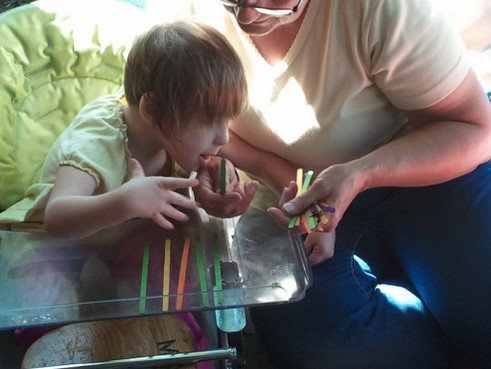
We began by making patterns with long colored craft sticks. Maggie who is 5 loved this activity and really liked picking which stick came next. Jack was not very interested in the whole thing and I discovered why and will share it a bit later.

craft stick pattern pictures

Maggie making patterns with craft sticks

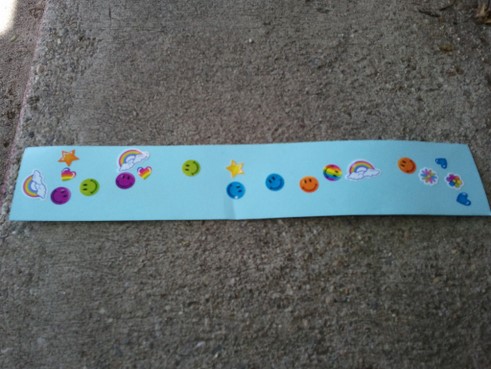
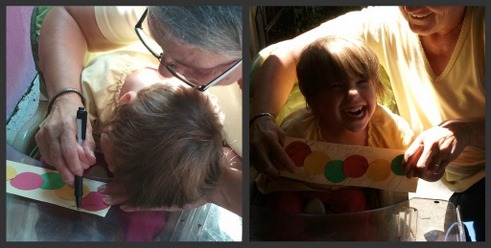
Next we used some colorful and varied stickers in a line to make a pattern on a long piece of paper. Jack wasn’t able to make a line but was putting all his stickers on one end in a clump. As Maggie and I worked on our pattern Jack began to notice what I meant when I said put them in a straight line. You can see from the picture below that he then was able to make a pretty straight line – that is until he ran out of space and was determined to keep adding stickers!

colorful sticker images

Jack was very proud of making a straight line

That is why Jack wasn’t interested in patterns. He is not ready for it. He still needs to learn concepts such as a straight line, making a curve, etc. which are also important for good mathematical reasoning. So we will revisit patterns many times this year and also more basic concepts while Jack learns.

We finished our section on patterns by making a caterpillar out of colored circles. As always everyone loves using glue!

simple patterns caterpillar picture

Maggie's simple pattern caterpillar

Then we focused on same and different. We made selections based on  color, shape and size, etc. I asked a lot of questions such as ‘How are these two objects the same? How are they different? What’s another way they are the same? How else are they different?’ Sometimes children may think that only one answer applies to “same and different” situations. I modeled my own reasoning, showing several ways the objects were the same and different.

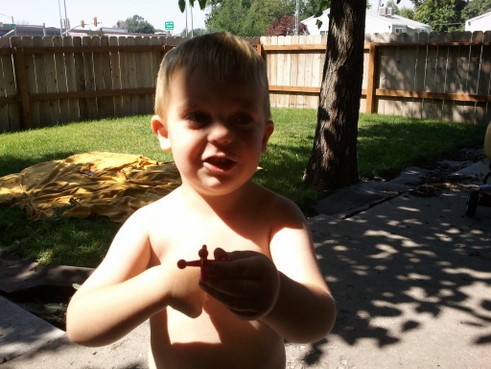
We began with items that were all the same but different colors and separated them by color. We used large wooden beads, jacks and beans. The most exciting part of this for Jack was discovering that jacks had his name. They were a Jack and he was a Jack!

little boy with his jack picture

Jack with his jack!

Jack was better able to do this type of simple sorting than he had been at  patterns.

Next we used items that were all different colors and shapes (shape blocks) and separated them by shape. So now we might have a blue triangle, a red one and a green one in the same pile. Maggie was able to do this well.

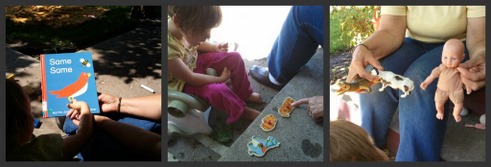
The book Same, Same introduced items which were different but which were the same because of stripes, size, or use. We played a number of games choosing which items were the same using puzzle pieces, toys and other house hold items.

kids learning same and different

What is the same and what is different?

Below are more math books that I found on that original library visit. They are on many varied concepts. I just had to give you the lists especially the list of math fiction.

Math Books for young Children:

Clifford’s Opposites by Norman Bridwell

Opposites by Active Minds (Knowledge of positions is key to giving and following directions. Here are words such as above, below, top, bottom, first and last.)

Math Fables by Greg Tang (a math riddle book-ages 3-6)

Math for All Seasons by Greg Tang (a math riddle book-ages 5-9)

Math Fables Too by Greg Tang (a math riddle book-ages 3-6)

Same Same by Marthe Jocelyn

Math Books for Older Children:

Math-terpieces by Greg Tang (math and art – ages 5-12)

Math Art: Projects and Activities by Carolyn Ford Brunetto (math and art – ages 5-12)

The Grapes of Math by Greg Tang (transition from adding to multiplying – ages 7-12)

Math Appeal by Greg Tang (sequel to the Grapes of Math – ages 7-12)

The Best of Times by Greg Tang (master multiplication through understanding not through memorization – ages 7-12)

Math Potatoes by Greg Tang (problem solving – ages 8-13)

Sideways Arithmetic from Wayside by Louis Sachar (puzzles and brain teasers ages 9-12)

Growing Patterns by Sarah C.Campbell(Fibonacci Numbers ages 8-13)

Math fiction books to read as a family:

Go,  Fractions by Judith Bauer Stamper

The Cat in Numberland by Ivar Ekeland

The Number Devil by Hans Magnus Enzensberger (ages 9-12)

Math Curse by Jon Scieszka (ages 5-12)

Babymouse: Dragonslayer by Jennifer Holm (ages 9-12)

Mummy Math by Cindy Neuschwander (ages 6-12)

The Potato Chip Puzzles by Eric Berlin (ages 8-12)

7 X 9 = Trouble by Claudia Mills (ages 6-12)

Spagetti and Meatballs for all!: a mathematical story by Marilyn Burns (ages 6-12)

The Lemonade War by Jacqueline Davies (ages 7-12)

The Curtain Went Up, My Pants Fell Down by Henry Winkler (ages 7-12)

Possibly Related Posts:


{ 5 comments }