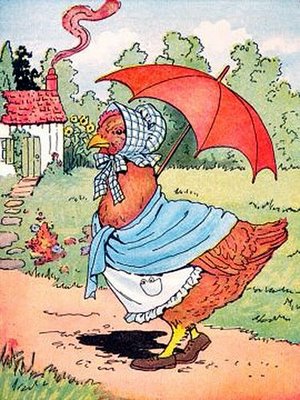
little red hen picture

Little red hen

Do you remember the story of the Little Red Hen? Oh, you remember, the hen with her chicks who found a grain of wheat. She asked for help to plant the wheat, harvest the wheat and grind the wheat. No one volunteered to help so she did it herself. When the bread was baked everyone wanted to eat the hot, sweet smelling loaf. However, she and her chicks ate it themselves. This is one of my family’s classic books. It teaches the virtues of  good actions, work ethic and personal initiative. It has been read and told over and over again in our home.

One of the best ways to teach children ages 0-12 is by reading them the classics. These are the foundational phases and the purpose is to give our children a firm foundation of core values upon which to build a great life. A classic is a work worth reading over and over again, because the student learns something each time. There are classics in each field from history, math, science, literature, the digital age, and even surfing, cycling, dancing, gardening etc. There are classics for every age group.

I personally believe that reading to our children, reading as a family and when ready, reading alone, are on the top of the list of ways to help children love learning and to help establish that firm foundation for a great life.
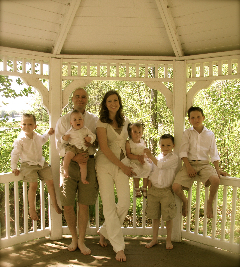
Norton family picture

The Nortons

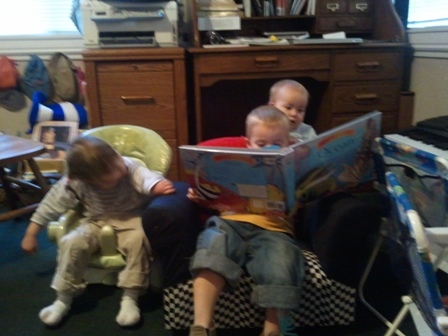
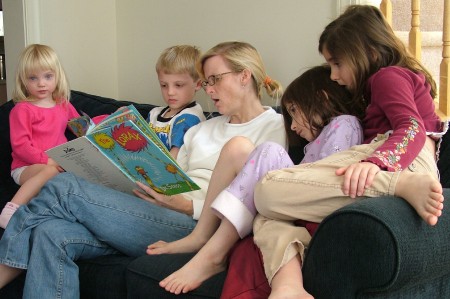
Now back to the Little Red Hen. One morning the Norton family read the book the Little Red hen during their family reading time. Then they all went grocery shopping. When they arrived home the car was full of groceries which needed to be carried in to the house. Now normally everyone would scatter off to do the next important thing but not today. The classic had had an impact and all the children began carrying in groceries without being asked.

Another classic that I found late in life was Little Britches. I wasn’t able to share it with my own children while they were at home but after I found it I began sharing it with my grandchildren. Set in the early 1900’s this story is told from the point of view of a young boy who moves from New Hampshire to Colorado with his family because his father is ill and cannot work the coal mines any longer.  Through the eyes of this young boy we experience the perils and pleasures of ranching life from picnics to hay season, tornadoes to cattle roundups. Some of the main story themes are hard work, honesty, character, perseverance, and the simple life.

In a class I am taking a mother related this story. She has two boys in the age group we are talking about. They have been

little britches picture

Little britches

reading Little Britches.

Recently the younger of the two boys shared some information about his brother which he knew he shouldn’t share and which caused his older brother some difficulty and embarrassment. In a private moment talking with his mom about the situation he said, “I guess I have taken some of the boards off of my house”, in reference to a comment by Ralph, the lead character in Little Britches. Ralph was referring to doing something that was destroying his house of character.

Reading regularly in family reading time from the classics, to our children, can be some of the most enduring and meaningful times we can have with them. My 33 year old mentioned recently how wonderful it was, the way I read to them all the time. Amazing!

I really didn’t read to them all the time. I read to them but it wasn’t consistent but see how powerful what I did do was. She remembered whatever was offered in such a positive light. Read to your children and read them your classics. If you want them to LOVE learning then read to them. Don’t worry so much about if they read. If you will read to them out of the best books they will learn to love learning and that will include reading.

In the mean time, you will help them build a firm foundation upon which to build a great life.

Possibly Related Posts:


{ 0 comments }

How I dealt with a stressful day

by Mary Ann on December 12, 2010

kids reading picture

Maggie, Jack and Mary

“Mom, it is probably a real blessing that you have my kids so much; it gives you lots of material for your blog”, my daughter said after a day that began at 7:00am and ended at about 1:30 am.

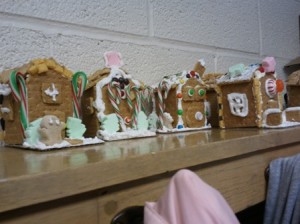
ginger bread houses pictures

A few of the gingerbread houses

Today Jodie and I are teaching 87  6th graders how to make a small gingerbread houses out of graham crackers. It is a hug project that takes over 10 hours of preparation in cutting crackers, dividing candies and making frosting. It is a gift to the three classes for the amazing fundraiser that they held for my granddaughter Maggie’s therapy.

But just because we have this special and challenging project going life doesn’t change. It just keeps right on going. Maggie still has 3 therapy sessions a day. Jack and Mary still have to be cared for. Meals for husbands have to be cooked. It keeps going on. I still have the families that I care for.

So after my morning session with a family that I work with, grandkids started arriving. That was at about 12 noon. Jodie and I began cutting crackers and bagging candy while fielding questions, resolving childish spats, keeping Mary out of the tree (which is now wired to the wall!), getting drinks, nursing, changing diapers…you get the picture. The going was slow. Then Jodie and Maggie were off to another therapy session and I stayed with the above process myself for the next few hours. Whew!

It just so happened that Jodie and Doug had a special evening planned with friends. Don and I had offered to watch the kids. That

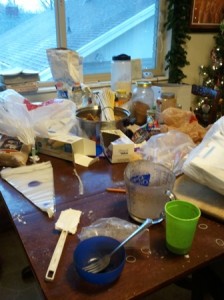
picture of messy kitchen

The Aftermath!

was all before the gingerbread class came up. So the children stayed on through the night. Don was helping me cut cardboard bases and taking care of children so I could keep cutting crackers. Yes, I was still doing that project at 6:00pm; too many interruptions to make much progress.

By 8:00 our nursing granddaughter was about at the end of her rope. She kept crawling into the kitchen and standing up via the backs of my legs and then falling down as I moved to pick her up. It hurt her feelings and then she would cry. Now this had happened more than once. Jack was on an adrenalin rush and was like a little wild man. You know how children get when it is really time for bed, they are tired and ready to go, but they don’t want to.

I kept watching the clock. I knew time was passing and I had at least 4-5 hours of prep left. It takes a lot of time to make seven batches of frosting and fill and rubber band 87 pastry bags. YIKES. The stress I was feeling was rising. I picked Mary up and as I walked out of the kitchen I had the most amazing desire to SCREAM!!!! Not at the children, just scream.

I hadn’t had that feeling for over 15 years. I mean it has been a long time and I had forgotten what that feels like. When I was a young mom I would have screamed. Then I would have started yelling at kids, a husband and anyone else in the near vicinity. But last night I swallowed it down and then I took my own advice. I STOPPED.

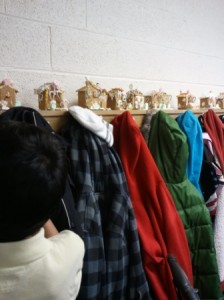
ginger bread house photos

A few more gingerbread houses

I looked at these sweet children and I STOPPED. I sat on the couch with Mary and held her close and fed her some juice in a bottle. I watched Jack and talked with him and Maggie. I let go of the feeling that I was running out of time that the world was going to explode if I didn’t get more done faster. You know what, Mary calmed down, Jack calmed down, and Maggie was laughing. I felt peace.

It was a long day and a long night. Jodie and I didn’t get all through our preparation for today until 1:30 this morning. But we did get it done. Children stayed happy. No one yelled.

I am making this confession because my daughter is right. Maggie’s condition has been a blessing to me. Because of it I have a number of children on a regular basis for quite a bit of time. It keeps my head in the game. It reminds me what it was like raising seven children and carrying a big load every day. It reminds me what its like to get to bed in the wee hours and then get up at 6. It reminds me how easy overload can happen.

When things are spinning out of control in your world just STOP. Focus for a small bit of time on what really matters, which is usually our family. Reevaluate the fires you feel you must put out. Give yourself a minute to regain your composure and your peace. We often think that running away from the chaos is the answer to avoiding stress and getting relaxed. In my experience, the solution to managing a chaotic situation, is to sit down in the middle of the chaos and hold a (screaming) child, listen, stay calm, breath and let go.

PS  As you can see the project was a wonderful success!!

Possibly Related Posts:


{ 0 comments }

Making rain stick in home school

by Mary Ann on December 10, 2010

granny child with rainstick picture

Grandma and Jack

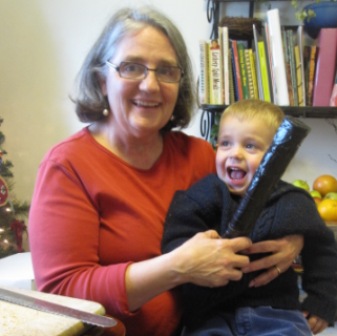
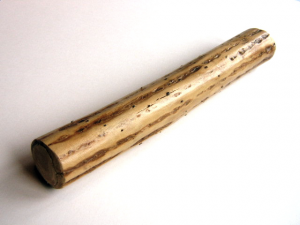
I was watching Jack, aged almost 3 and Mary, 10 months. It was getting crazy. I was trying to write a blog and keep the tree from tipping over for the third time that day. I was thinking in my brain, “What can I get Jack interested in?” We have a large rain stick in the living room behind the couch. So I got that out.

Rainstick picture

Rainstick

Jack was fascinated. He turned it over and over again to hear it “rain”. I asked him if he knew how the rain stick worked. He didn’t. So I used my fingers to explain how there were crossed spins inside and small seeds. When the seeds hit the spines they make the sound. I could see that he was a bit confused.

cactus picture

cactus

“Jack, do you know what a cactus is?” “No?” “I’ll bet we can find one on the computer.” (I didn’t have any books on cacti in my Spark Station or in the library.) So we went to the computer and pulled up some pictures of cacti with long arms. I explained that when the cactus dies the arms can be made into rain sticks before they dry. I showed him some cacti with long spins and explained that the spines are pushed into the dead cactus. We got our rain stick and I was able to let him feel the ends of the spines in the stick.

Then, with Jack on one knee and Mary on the other, we googled “making a rain stick.” make Rain Stick pictureThe first thing up was a video series showing how to make a rain stick from a cardboard tube. We watched the video on how to choose a tube. We watched how to put in the spines, which were nails, pins or toothpicks. We watched the first part of how to cover the ends and we finished off with the video on what to put inside.

Jack was fascinated and watched all the videos. I helped him stay tuned in by having a running “familiar conversation”. “Look Jack, there are three lengths of tubes. Which size would you choose?” “Hey, look she is using nails and a hammer. You would like to hammer nails I bet.” “See those toothpicks, they would make a really different sound.” It went on and on and he was fully engaged with how it was done. (The hardest part so far was keeping Mary’s hands busy and off the key board!)

“You know what Jack, I’ll bet we can make a rain stick.” “Yeahhhhh”, he said. So we went to our really great junk box and found a long tube that we thought might work. I handed it to Jack, he put it up to his eye and said, “Hey, its my looker looker”; so much for the rain stick. The only other tubes we had were toilet paper tubes. I though it might work.

We went into the kitchen with our tube, some straight pins and duck tape. Jack was content to watch me make the stick. He tried pushing in a pin but decided it hurt his thumb. So we talked about dead cacti, thorny spines and rain sticks while I pushed in pins and taped on an end. Jack chose red lentils and some rice to go inside. He was interested with how the spines looked inside the tube. He understood now what I had been showing him with my fingers and he showed it back to me. Then I taped the other end and covered the whole thing with duck tape. A rain stick is normally covered with paper or cloth and then painted or decorated but I wanted to be sure those pesky pins didn’t come out.

Jack excitedly turned it over. It didn’t “rain”. There was just a spattering thunk. Hmmmmm. He tried it a few times. Then he looked at me and with a serious face said, “It’s too little (meaning short). He had figured out that there was no rain sound because the tube was too short. Amazing! Aren’t children smart.

I told him that we could construct a rain stick out of three toilet paper tubes taped together. He was all for that and rummaged in the junk box for the tubes. Then his enthusiasm waned. He and Mary busied themselves with trucks on the living room carpet while I taped the tubes. Then I called Jack in and told him I was going to use toothpicks this time and showed him how it worked. Then he was off with Mary and the trucks. I finished the tube and called Jack in to put the rice inside. I finished taping the ends and covered it with duck tape.

smiling boy picture

Happy Jack

Then I called Jack in and he gave it a try. His face just beamed when it “rained.” When his mom got home he showed her the rains stick and I told her about the dead cactus. She looked at Jack and said, “Jack knows about cacti. Remember the story about the boy and his bottom.” A wide grin spread over Jacks face as he recalled the Dr. Seuss story about a boy who sat on a cactus. Now it all came together in his mind.

It was a great time. And how much time did we spend; about 40 minutes. That is all, for the videos, the conversations and the making. Just a mere 40 minutes,and it was almost like we did a lesson on rainsticks. Then I wrote my blog and Jack and Mary played with the trucks.

Helping children LOVE learning (begin learning) is about catching a spark from a child (in this case seeing his interest in the rain stick) and then responding and encouraging to learn. It doesn’t have to take a lot of time. It doesn’t have to take a huge amount of preparation. You just need to stop doing your own thing and choose to help them do theirs.

I have since made a trip to the library. I have some books on cacti and musical instruments in my Spark Station for when Jack comes again. Who knows, maybe we will make one or two.

Possibly Related Posts:


{ 0 comments }

reading to children pictures
“I’ve started this Structured Family Time and wow is it hard to settle down to doing that. It works for us to do it on M,W,F starting at 9 in the morning, so we read scriptures, read from a classic, and have family prayer for the opening part. Then I let them choose the activities they want to do until the afternoon. The Spark Station is available during that time and they do use it.

I just listened to the recording on being present and it says that the mom shouldn’t be doing other things during structured family time, except being there for the children. (Or at least that’s how I’m hearing it.) I give them an hour of focused time during our opening, but then I’ve been doing my projects while they do theirs, stopping if they need my help. My children range in age from 8 years to 17, so are able to do most of what they do on their own. I find that I do better during that time if I’m not on the computer or listening to my mp3 player, because then when they need me, it feels like they are interrupting me and I get annoyed when it keeps happening.

My question is: Should I not be doing my projects during that time? And if not, what should I be doing while they’re all busy doing their stuff?

I’m so excited to be taking this course. Thanks for all your great information!”

Melody

Let’s look at the questions in Melody’s email. First, structured time and being present are difficult because they challenge how we live most of life, running from one thing to another while thinking about the other 10 things we need to do.
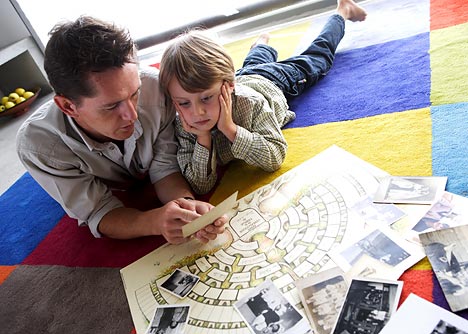
father and son playing reading picture

Structured time is about stopping long enough to listen, hear and respond to our children. That is why it is so valuable because it can’t help but affirm the belief that “I matter, I am important” because it is so different than how we really live life.

The truth is that it will take time to feel comfortable with structured time. It will take time to quiet your brain and it frankly, takes time not to have the feeling that you need to get on to what is really important. That is always hard to admit because we want to believe that we think our family and children are most important but often our actions don’t tell that same story.

In thinking about it a lot, I have decided that it is a matter of what seems to be most imperative right now. Preparing for the church play, the PTA meeting, laundry, they are all imperative, they have deadlines. Children don’t have discernible deadlines. They are with us every day. There is always tomorrow to get to them. But I can tell you from experience that time will pass fast and that there is definitely a deadline with the wonderful things that we want to do with our families.

Melody asks, “Should I not be doing my projects during that time? And if not, what should I be doing while they’re all busy doing their stuff?”

guy with earphones pictureWell, in my opinion it depends on your projects. The computer, in my mind, is a no no, because it sucks us in so completely. It is hard to tear away. When we are called upon for help the usual answer is “just a minute” while we finish an email, etc.  The computer and an MP3 player are sort of isolating activities. Watch people on the street with their IPod, MP3’s and so forth and they just seem to shut others out.

Of course it goes without saying that if your projects are dishes, laundry, talking on the phone, vacuuming, or doing anything in another room or that requires you to make trips in and out of the structured time area, then it is on the no no list. You can’t give your children the sense that this time really matters and that they really matter if you are doing what you do all day, every day.

Structured time is the perfect time to model what you want so I say read, write and then discuss with your children.

Melody also mentions, “I find that I do better during that time if I’m not on the computer or listening to my mp3 player, because then bothered badge picturewhen they need me, it feels like they are interrupting me and I get annoyed when it keeps happening.”

I’d like to talk about the issue of feeling interrupted. Even if you are reading and writing that feeling can and probably will occur. I find that it helps to go into it knowing that whatever I am doing is an example I am setting and that my real intent is not to make discernible progress but to model a behavior that I want children to see.

I also find it helpful to just observe. If the 17 year old is reading a book on President Woodrow Wilson , ask a question, “Do you like the book,what do you think about the President”. See where that conversation goes. If you have read the book make a comment about what you thought and felt.

If your 8 year old is building with Leggo”s make a comment, “I noticed that you spent some time thinking about what you were going to build before you started”. Then listen. I love “familiar conversations” because they keep me involved, give me a feeling that I am doing some good work, and give me an opportunity to listen. If no one really engages in a conversation then read.

Be aware that whatever you do there will be a tendency to feel interrupted. I guess that is why I spend a lot of time just observing and participating where I can. And in the final analysis remember that your real job during this  time is to respond. You can’t do that if you aren’t mentally there or if you have any other agenda than being with and enjoying your children.

Possibly Related Posts:


{ 0 comments }